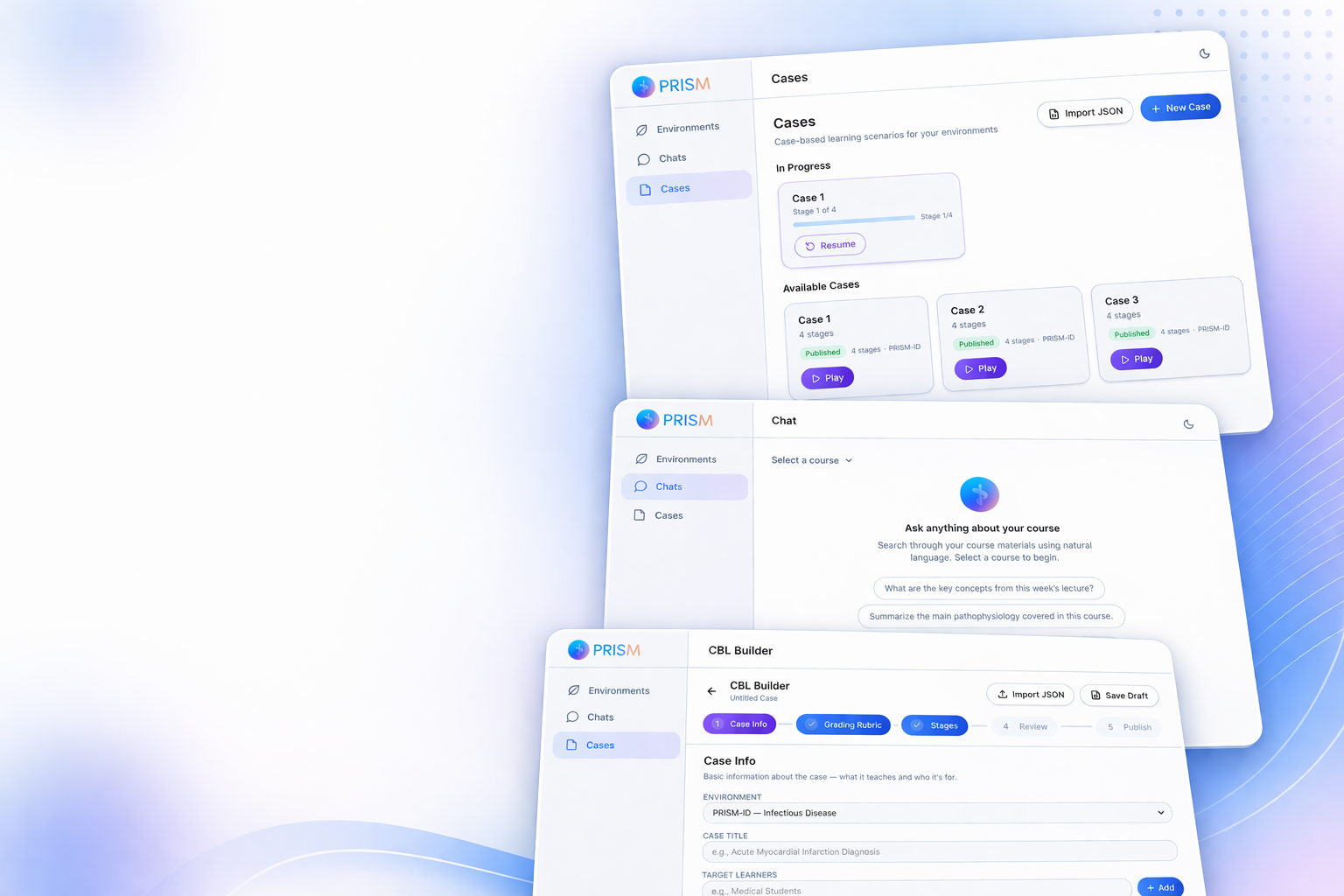
Faculty authoring
Faculty can upload course material, define learning objectives, shape AI behavior, create assessments, and build Case-Based Learning experiences without custom software work.
 Equanimity Labs
 PRISM by Equanimity Labs helps institutions turn course materials and faculty intent into deployable AI teaching assistants, Case-Based Learning experiences, and curriculum-grounded study support.
PRISM is built for medical schools, training programs, specialty societies, and CME organizations that need more than a generic AI layer. Faculty and institutions can use the platform to create course tools, ground them in their own material, and deploy them across courses, classrooms, programs, and partner education settings.
Faculty can upload course material, define learning objectives, shape AI behavior, create assessments, and build Case-Based Learning experiences without custom software work.
Faculty-designed CBL experiences guide learners through authentic clinical reasoning, helping programs turn teaching priorities into sequenced case progression rather than static cases or open-ended chat.
Learner-facing support stays grounded in faculty material and course boundaries, and can be deployed across courses, classrooms, programs, and partner-led educational settings.
The platform is designed to follow the way medical education already works: faculty authorship first, curriculum grounding next, and controlled deployment into real educational settings.
Faculty and institutions can upload their own material, define objectives, and create AI teaching tools shaped by the curriculum they already teach.
Documents, faculty guidance, and program boundaries stay close to the experience so learners engage with course-specific expectations rather than generic responses.
PRISM can be used across courses, classrooms, training programs, specialty-society education, and CME delivery models where operational fit matters alongside pedagogy.
For pre-clinical and clinical settings where faculty want to author and deploy curriculum-grounded Case-Based Learning and study support at course level.
For residency and fellowship programs that need trainee assessment and guided AI teaching tools built around their own learning objectives, cases, and teaching priorities.
For groups that need interactive, controlled continuing medical education modules with stronger deployment and engagement options than static content alone.
Case-Based Learning is a well-established method in medical education. It links theory to practice through authentic clinical cases and strengthens reasoning, problem solving, and decision making. PRISM is designed to help institutions scale that approach beyond the faculty available to deliver it.
PRISM is designed around faculty-authored clinical scenarios that move learners through guided reasoning, not just information retrieval.
Case-based Learning in Medical Education - McGraw-Hill Red Paper
We focus on pedagogical AI that supports learning, sharpens reasoning, and reinforces faculty intent rather than replacing thought with automation.
The system should amplify how educators teach rather than replace their role in authoring, framing, and evaluating reasoning.
Product decisions should reflect the workflows, constraints, and institutional context of real academic programs.